
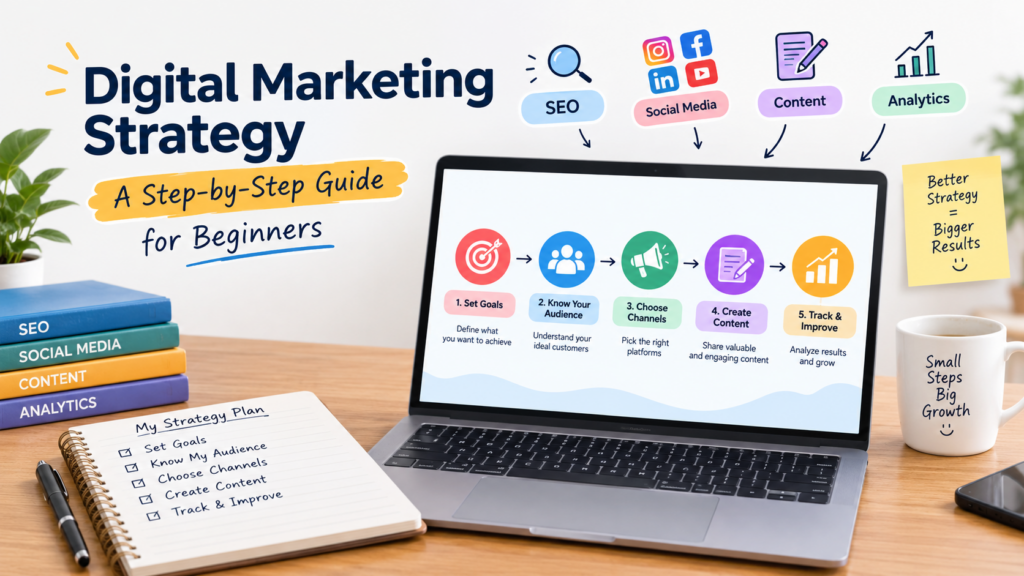
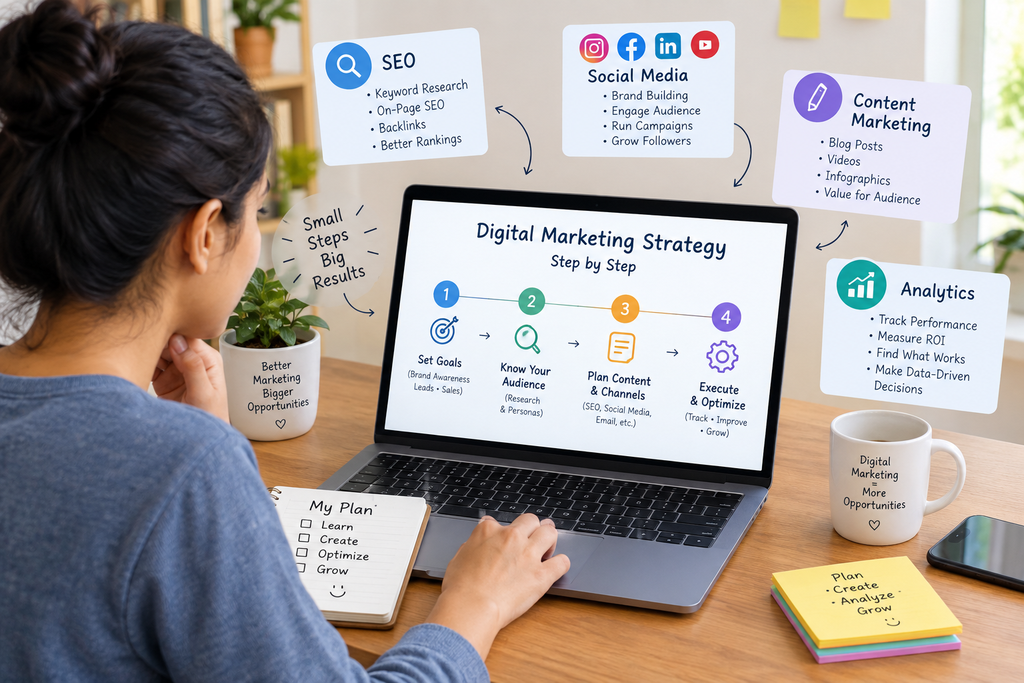
Today, many businesses use the internet to reach customers. They use websites, search engines, social media, emails, and online ads to promote their products or services.
But simply being online is not enough.
Posting on social media without a plan or running ads without knowing your target audience may not give good results. This is why every business needs a digital marketing strategy.
A digital marketing strategy is a simple plan that helps a business decide what it wants to achieve, who it wants to reach, which online channels it should use, and how it will measure its results.
The good news is that creating a digital marketing strategy does not have to be difficult.
In this guide, we will explain how beginners can create a digital marketing strategy step by step.
What Is a Digital Marketing Strategy?
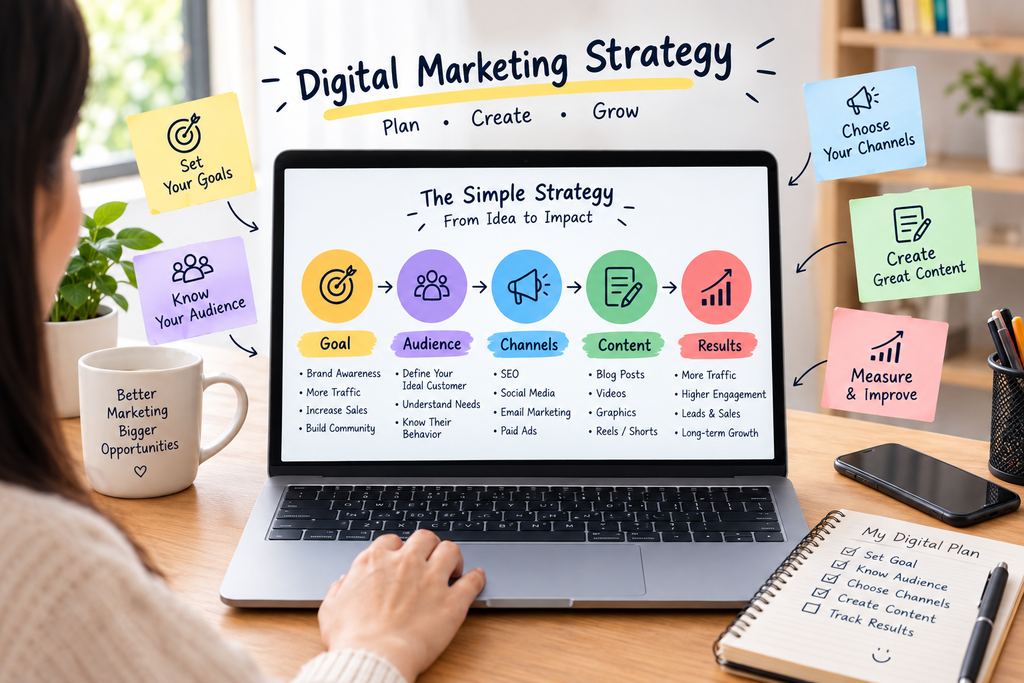
A digital marketing strategy is a plan for promoting a business online.
It helps you answer some important questions:
- What is my goal?
- Who are my customers?
- Where can I find them online?
- What type of content should I create?
- How much should I spend?
- How will I know if my marketing is working?
For example, posting a photo of your product on Instagram is a marketing activity.
But deciding what to post, who you want to reach, what action you want customers to take, and how you will measure the results is a marketing strategy.
A strategy gives your marketing a clear direction.
Step 1: Set Clear Marketing Goals
The first step is to decide what you want to achieve.
Without a clear goal, it becomes difficult to know whether your marketing is successful or not.
Your goal could be:
- Getting more website visitors
- Getting more customer enquiries
- Increasing sales
- Building brand awareness
- Getting more leads
- Bringing existing customers back
Try to make your goal clear and measurable.
For example:
Weak goal:
“I want to grow my business.”
Better goal:
“I want to increase website enquiries by 20% in the next three months.”
The second goal is better because you can measure the result.
Beginner Tip
Start with one or two important goals. Do not try to achieve everything at the same time.
Step 2: Know Your Target Audience
Once you know your goal, the next step is to understand your customers.
Your target audience is the group of people who are most likely to buy your product or service.
Your target audience is the group of people who are most likely to buy your product or service.
- Who needs my product?
- How old are they?
- Where do they live?
- What are their interests?
- What problems do they have?
- What do they need from my business?
For example, imagine you own a small clothing business.
Your target audience could be young people who live in your city and are interested in affordable and stylish clothes.
Knowing your audience helps you create better content and choose the right marketing channels.
Remember
You do not have to market your business to everyone.
It is better to reach the right people than to reach a large number of people who are not interested in your product.
Step 3: Study Your Competitors
Before creating your strategy, take some time to look at your competitors.
Competitors are businesses that sell similar products or services.
You can check their:
- Websites
- Social media pages
- Online advertisements
- Content
- Customer reviews
- Offers and promotions
Look at what they are doing well and where they may be missing something.
For example, if your competitors answer customer questions slowly, you can make quick customer support one of your strengths.
The purpose of competitor research is not to copy them.
Instead, it helps you understand the market and find ways to make your business different.
Step 4: Choose the Right Digital Marketing Channels
There are many ways to market a business online.
Some common digital marketing channels are:
SEO
Search Engine Optimization (SEO) helps your website appear in search engine results when people search for information related to your business.
Social Media Marketing
Platforms such as Instagram, Facebook, and LinkedIn can help businesses connect with their audience and build awareness.
Content Marketing
This means creating useful content such as blogs, videos, guides, and posts to help and educate your audience.
Email Marketing
Email can help businesses stay connected with customers and share useful information, offers, or updates.
Paid Advertising
Online ads can help businesses reach a specific audience and bring traffic, leads, or sales.
WhatsApp Marketing
Businesses can use WhatsApp to communicate directly with customers, answer questions, and share updates.
Which channel should you choose?
You do not need to use every channel.
Choose the channels where your target audience is most likely to spend time and where your business can get useful results.
For example, a local business may focus on Google and social media, while an online store may use SEO, social media, email, and paid advertising.
Step 5: Create a Content Strategy
Content is an important part of digital marketing.
But creating content without a plan can become confusing.
A content strategy helps you decide:
- What should you post?
- Who is the content for?
- What problem does it solve?
- Where should you publish it?
- How often should you post?
You can create different types of content, such as:
Educational Content
Teach your audience something useful.
Example:
“5 Things to Check Before Buying Running Shoes”
Problem-Solving Content
Help people solve a common problem.
Example:
“How to Remove a Coffee Stain from a White Shirt”
Informational Content
Share useful information about your product, service, or industry.
Promotional Content
Tell people about your products, services, offers, or new launches.
Trust-Building Content
Share customer reviews, success stories, or useful information that helps people trust your business.
Beginner Tip
Do not make every post an advertisement.
People are more likely to follow a business when it gives them useful information instead of only asking them to buy something.
Step 6: Build a Simple Marketing Funnel
A marketing funnel shows the journey a person takes before becoming a customer.
A simple funnel looks like this:
Awareness → Interest → Consideration → Purchase → Retention
Let’s understand it with a simple example.
Imagine someone sees your business on Instagram.
1. Awareness
The person learns that your business exists.
2. Interest
They become interested and visit your website or social media page.
3. Consideration
They check your products, prices, reviews, or other information.
4. Purchase
They decide to buy your product or contact your business.
5. Retention
After the purchase, you stay connected with the customer and encourage them to return.
Understanding this journey helps you create the right content for people at different stages.
Step 7: Plan Your Marketing Budget
Digital marketing can be done with both free and paid methods.
For example, creating social media posts or writing blogs can be part of organic marketing. Paid ads require a budget.
If you are a beginner, you do not always need a large budget.
Start with a small amount and test your marketing.
A simple approach is:
Test → Measure → Improve → Scale
First, test your idea.
Then, check the results.
If something works well, improve it and slowly increase your investment.
This approach can help you avoid spending a large amount of money without knowing what works.
Step 8: Turn Your Strategy Into an Action Plan
A strategy is useful only when you take action.
Create a simple schedule for your marketing activities.
For example:
| Day | Activity |
| Monday | Plan content |
| Tuesday | Create content |
| Wednesday | Publish content |
| Thursday | Work on SEO |
| Friday | Check marketing results |
You can change this schedule according to your business and available time.
The important thing is to stay organised and consistent.
Step 9: Track Your Results
After starting your marketing activities, you need to check the results.
This tells you what is working and what needs improvement.
Some useful metrics include:
Website Traffic
How many people are visiting your website?
Leads
How many people are showing interest in your product or service?
Conversion Rate
How many visitors take the action you want them to take?
Engagement
How many people like, comment, share, or interact with your content?
Cost Per Lead
How much money are you spending to get one lead?
Sales
How many sales are coming from your marketing efforts?
Return on Investment
How much money are you earning compared with what you are spending?
Remember, likes and followers are not the only signs of success.
If your goal is to generate leads, then leads and conversions are more important than simply getting more followers.
Step 10: Analyze and Improve Your Strategy
Digital marketing is not a one-time activity.
You cannot create a strategy today and never check it again.
Review your results regularly and ask:
- What is working?
- What is not working?
- Which content gets better results?
- Which channel brings more customers?
- Where are we spending too much money?
- What can we improve?
For example, if one type of content gets more website visits than another, you can create more content around that topic.
The basic process is:
Analyze → Improve → Test → Repeat
This helps your strategy become better over time.
Common Digital Marketing Mistakes Beginners Should Avoid
Beginners often make a few common mistakes.
1. Trying Every Platform
You do not need to be active on every social media platform.
Focus on the channels that matter to your audience.
2. Marketing Without a Goal
If you do not know what you want to achieve, it becomes difficult to measure success.
3. Posting Random Content
Create content with a purpose instead of posting just because you have not posted for a few days.
4. Copying Competitors
Use competitor research to learn, not to copy.
5. Focusing Only on Followers
A large number of followers does not always mean more sales.
6. Expecting Fast Results
Some marketing methods take time to show results. Give your strategy enough time and make changes based on data.
7. Not Checking Results
If you do not track your results, you will not know what is helping your business.
Digital Marketing Strategy Checklist for Beginners
Before starting your strategy, make sure you have:
☐ A clear marketing goal
☐ A defined target audience
☐ Basic competitor research
☐ The right marketing channels
☐ A content plan
☐ A simple marketing funnel
☐ A planned budget
☐ An action plan
☐ A way to track results
☐ A regular improvement process
Conclusion
Creating a digital marketing strategy may sound difficult, but it becomes much easier when you break it into simple steps.
Start by setting a clear goal. Then understand your audience, study your competitors, choose the right marketing channels, create useful content, plan your budget, and track your results.
You do not need to do everything at once.
Start small, learn from your results, and improve your strategy over time.
A good digital marketing strategy is not about being everywhere. It is about reaching the right people, with the right message, on the right channel, at the right time.
If you are a beginner, the best time to start building your digital marketing strategy is now.